Why this decision matters early
Multi-tenancy is one of those architectural decisions that is easy to defer and painful to retrofit. Get it right early, and your platform scales cleanly as you add customers. Get it wrong, and you spend months untangling data isolation issues that should never have existed.
This guide covers the three main patterns, their trade-offs, and practical guidance on when to use each one.
What multi-tenancy actually means
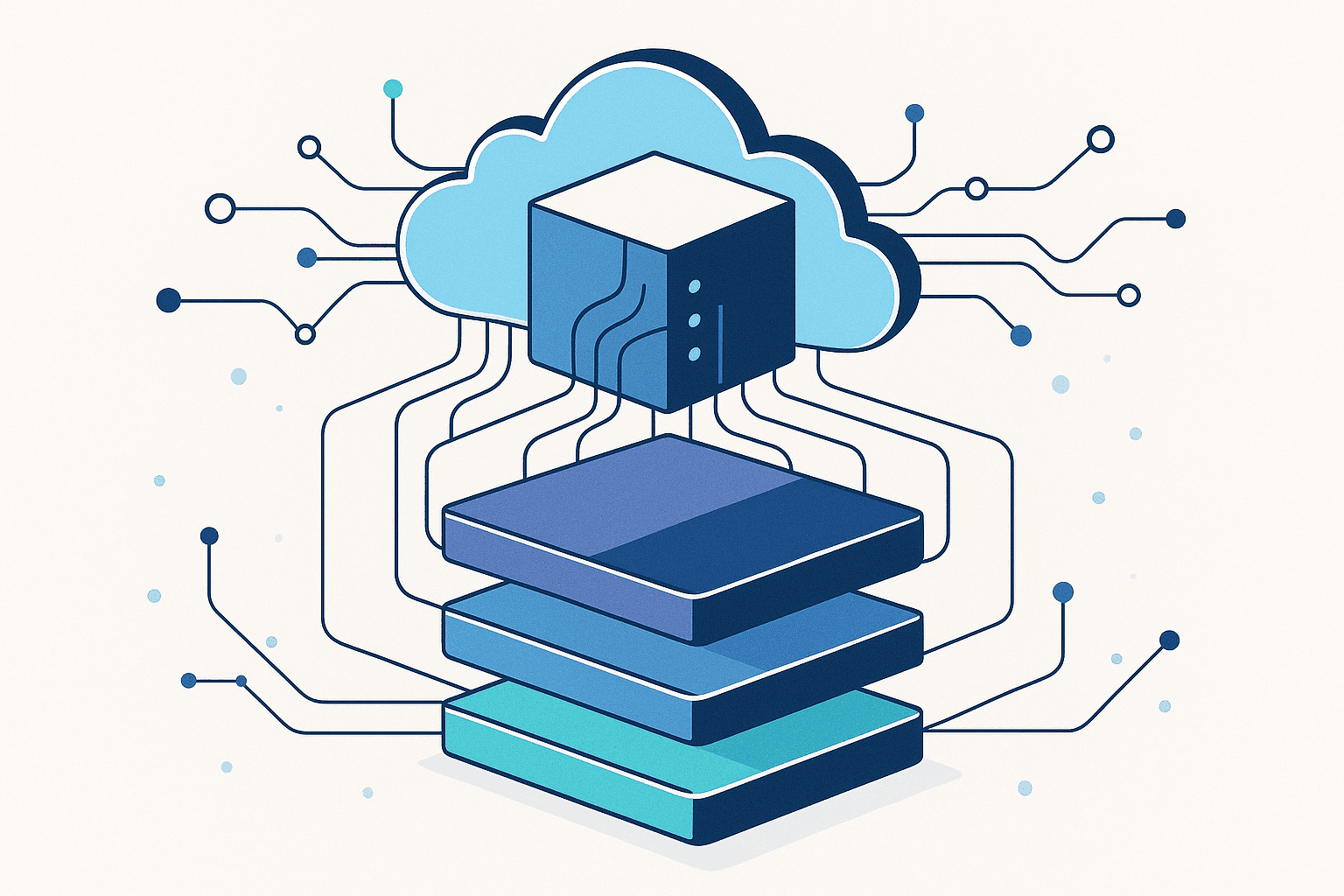
In a multi-tenant system, a single deployment of your application serves multiple customers (tenants). Each tenant's data is isolated, but they share the same infrastructure, application code, and often the same database.
The alternative, single-tenancy, gives each customer their own deployment. This is simpler to reason about but expensive to operate at scale.
Pattern 1: Shared database, shared schema
All tenants share the same database and the same tables. A tenant_id column on every table determines which rows belong to which tenant.
How it works:
- Every query includes a
WHERE tenant_id = ?clause - Application middleware injects the tenant context from the authenticated session
- Indexes on
tenant_idkeep query performance consistent
Advantages:
- Lowest infrastructure cost per tenant
- Simplest deployment model (one database, one app instance)
- Schema migrations apply once and affect all tenants
Risks:
- A missing
tenant_idfilter leaks data across tenants. This is the most common security bug in multi-tenant systems. - Noisy neighbor problems: one tenant running heavy queries degrades performance for everyone
- Harder to comply with data residency requirements (all data in one database)
Best for: Early-stage B2B SaaS with cost constraints and fewer than 100 tenants. If your team is small and you need to ship fast, this is the pragmatic choice.
Pattern 2: Shared database, separate schemas
Each tenant gets their own database schema (namespace) within the same database instance. In PostgreSQL, this means separate schemas. In MySQL, separate databases on the same server.
How it works:
- Tenant is resolved at connection time, and the schema/search path is set accordingly
- Each tenant has identical table structures but completely isolated data
- Migrations must be applied per schema
Advantages:
- Stronger data isolation than shared schema (no risk of missing WHERE clauses)
- Easy to back up or export a single tenant's data
- Can grant direct database access to tenants for reporting
Risks:
- Schema migrations become more complex (you are running them N times)
- Connection pooling gets tricky as the number of schemas grows
- At 1000+ tenants, the number of schemas becomes a management burden
Best for: Mid-stage B2B SaaS where data isolation is a selling point and you have 10-500 tenants. Common in industries with compliance requirements like finance and healthcare.
Pattern 3: Separate databases per tenant
Each tenant gets a dedicated database instance. The application routes connections based on tenant context.
How it works:
- A tenant registry maps each tenant to their database connection string
- Application middleware resolves the tenant and connects to the right database
- Each tenant's data is physically isolated
Advantages:
- Strongest isolation. A bug in one tenant's data cannot affect another.
- Per-tenant performance tuning and scaling
- Easiest path to data residency compliance (deploy tenant databases in specific regions)
Risks:
- Highest infrastructure cost
- Operational overhead scales linearly with tenant count
- Cross-tenant analytics require aggregation pipelines
Best for: Enterprise SaaS where customers demand dedicated infrastructure, or regulated industries where physical data isolation is a compliance requirement.
Hybrid approaches
In practice, many successful B2B SaaS products use a hybrid model:
- Free and small tenants on a shared schema for cost efficiency
- Paid and enterprise tenants on dedicated schemas or databases for isolation
- Tenant tiering that automatically promotes tenants as they grow
This gives you the economics of shared infrastructure for the long tail while meeting enterprise requirements for your largest customers.
Implementation checklist
Regardless of which pattern you choose, these fundamentals apply:
Tenant resolution: Decide how you identify the tenant. Common approaches: subdomain (acme.yourapp.com), request header, JWT claim, or URL path. Pick one and enforce it consistently.
Middleware enforcement: Tenant context should be injected at the middleware layer, not sprinkled through business logic. Every database query should automatically scope to the current tenant without developers remembering to add filters.
Testing: Your test suite should include multi-tenant scenarios. Run the same test as Tenant A and Tenant B and verify they cannot see each other's data. This catches the most common class of multi-tenancy bugs.
Backups and restore: Can you restore a single tenant's data without affecting others? Test this before your first customer asks for it.
Tenant onboarding automation: Creating a new tenant should be a single API call, not a manual runbook. If adding a customer requires SSH access to a server, your onboarding does not scale.
The decision framework
| Factor | Shared Schema | Separate Schema | Separate Database |
|---|---|---|---|
| Cost per tenant | Lowest | Medium | Highest |
| Data isolation | Logical | Logical + namespace | Physical |
| Migration complexity | Low | Medium | High |
| Max practical tenants | 10,000+ | 500-1,000 | 50-200 |
| Compliance readiness | Low | Medium | High |
| Operational overhead | Low | Medium | High |
Start with the simplest pattern that meets your isolation requirements. You can always migrate to a stronger isolation model later, but going the other direction is much harder.
The bottom line
Multi-tenancy is not a feature. It is an architectural foundation that affects every layer of your stack. Choose your pattern based on your current scale and your customers' isolation requirements, not on what you might need in three years.
Build the simplest version that works, invest heavily in tenant-aware middleware and testing, and plan your migration path for when you outgrow it.
Building a multi-tenant B2B platform? Talk to our team about how we architect tenant isolation for scale.